
 |  |  |  |  |  |
|---|---|---|---|---|---|
 |  |  |  |  |  |
 | 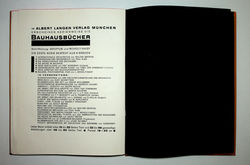 |  |  |
Adolf Meyer. Ein Versuchshaus des Bauhauses. München: Albert Langen, 1925 (Bauhausbücher; 3)
“At this point, the middle of the decade, Weimar saw the initial stages of the official output of the Bauhaus, a series of books that, it is no exaggeration to say, defi ned the era. In all probability they composed one of the most important collections of educational-theoretical books of art history in the twentieth century. I am talking about the famous Bauhausbücher, which began publication in 1925, when Walter Gropius was already thinking of transferring the Bauhaus from Weimar to Dessau, a move completed in 1927. Given the cultural and educational authority the Bauhaus had attained in just a few years and the worldwide esteem in which it was held, the infl uence exerted by these books, fourteen in all between 1925 and 1930, has still not been fully evaluated. But it was huge and decisive in many artistic and cultural environments internationally (...) As if the content weren’t enough, the series also had its own coordinated typographic line and a layout of Constructivist inspiration, but revised and corrected by Moholy-Nagy, who also designed all the book bindings. Though derived from Constructivism, layouts were orthogonal (static), rather than diagonal (dynamic); the palette was two-color (red-white or black-white); and photomontage was sharp and clean. Exemplifying what we will call the “Bauhaus style,” these genuine masterpieces of graphic design now have their own place in the history of the avant-garde book in the twentieth century.”
The avant-garde applied, 1890-1950. Madrid: Fundación Juan March, 2012 (p. 184-185)